Learn the field before going out.
AIDAS is an open training platform that teaches, measures and certifies engineers and architects in post-earthquake building damage assessment under the decision procedure of Türkiye’s 2025 regulation (Annex EK-1). It works on real field photographs and UAV video; you make every decision first, and only then may the AI offer a second opinion.
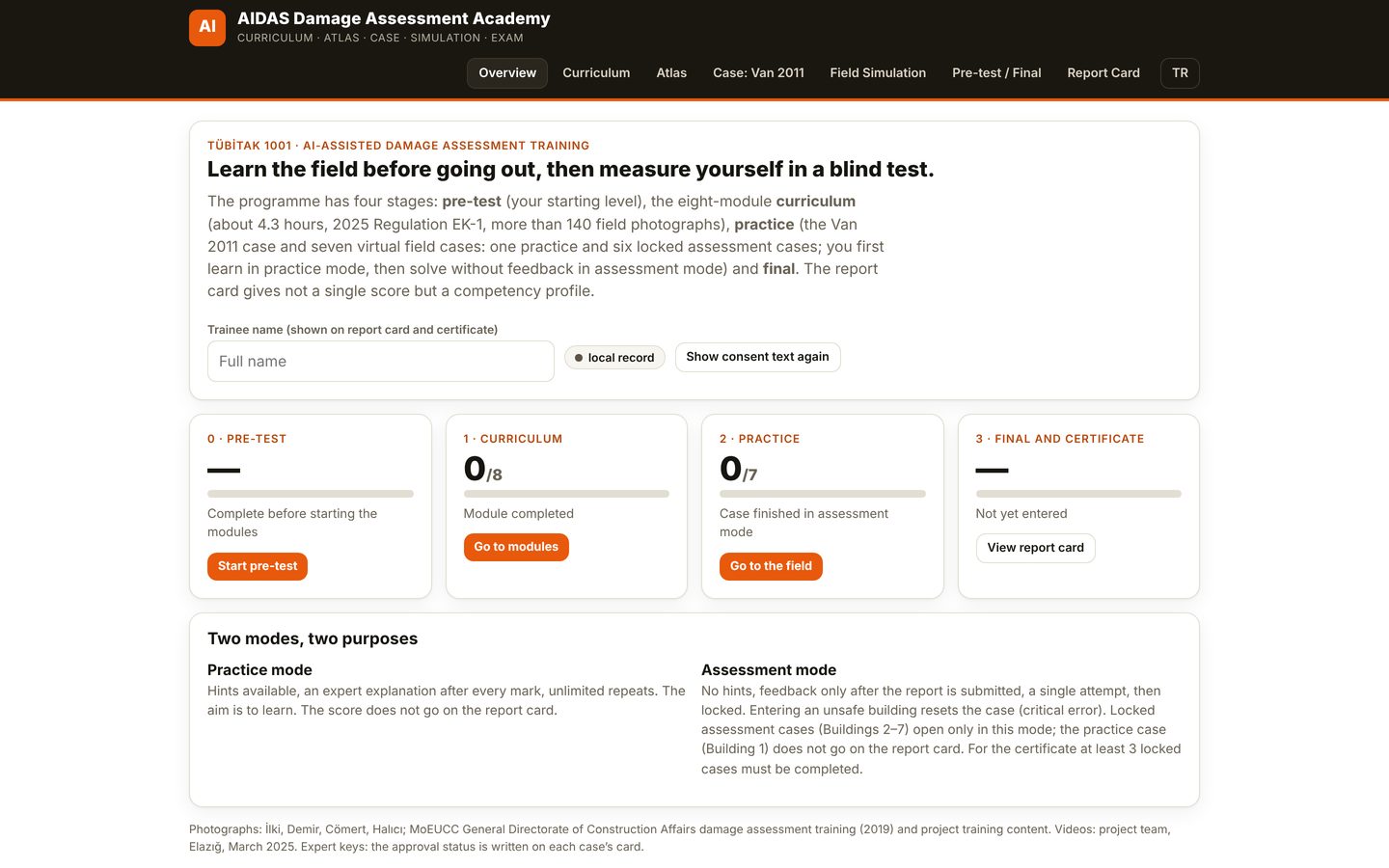
What is inside
Teaching, practice and measurement in one place. Every item is grounded in the verbatim text of Table 2.1 of the 2025 regulation.
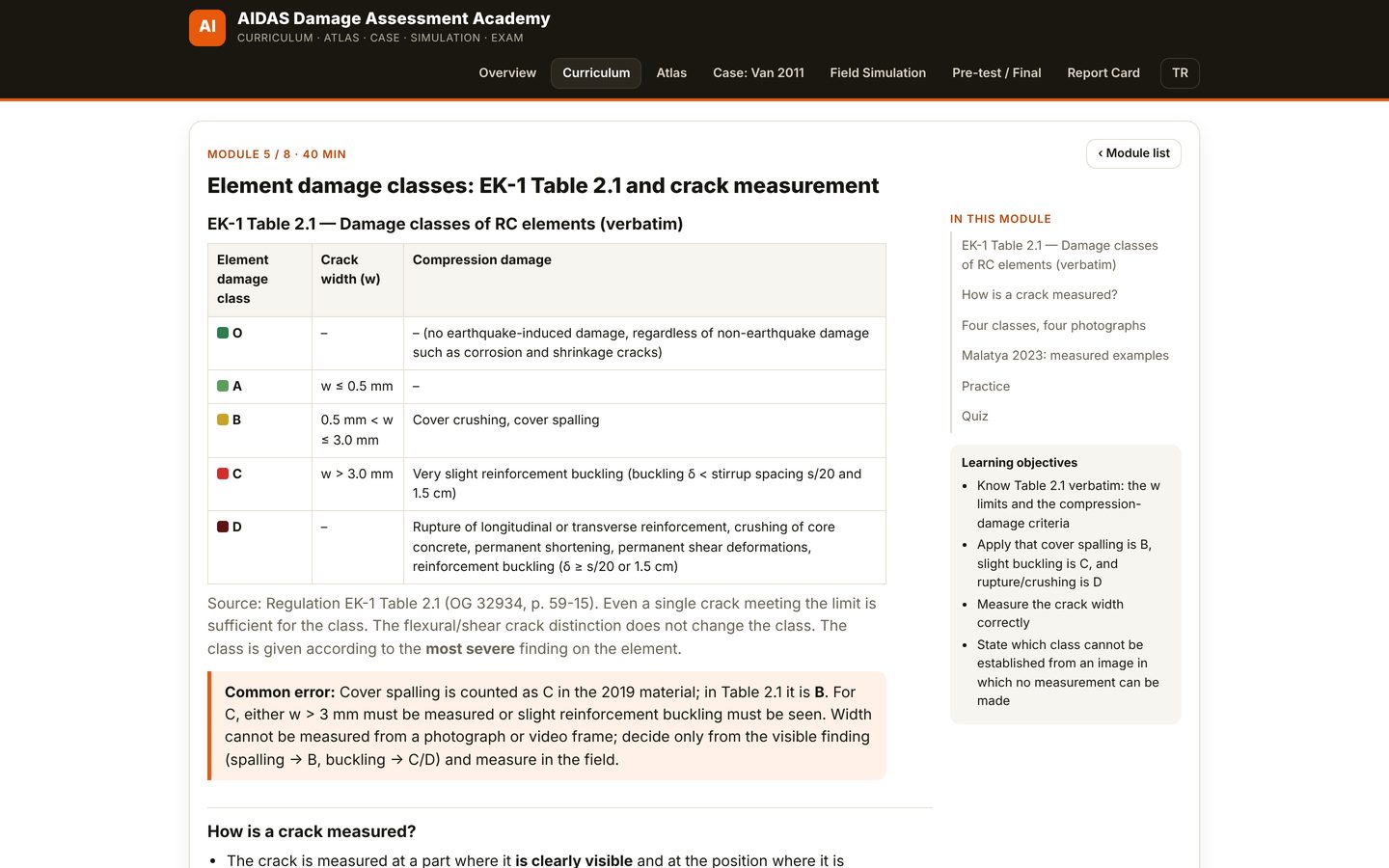
Curriculum
Eight modules: the assessment process, field safety, exterior inspection, element damage classes (Table 2.1), crack measurement, masonry buildings, the Category-2 calculation (DEAHY) and reporting. About 4.3 hours.
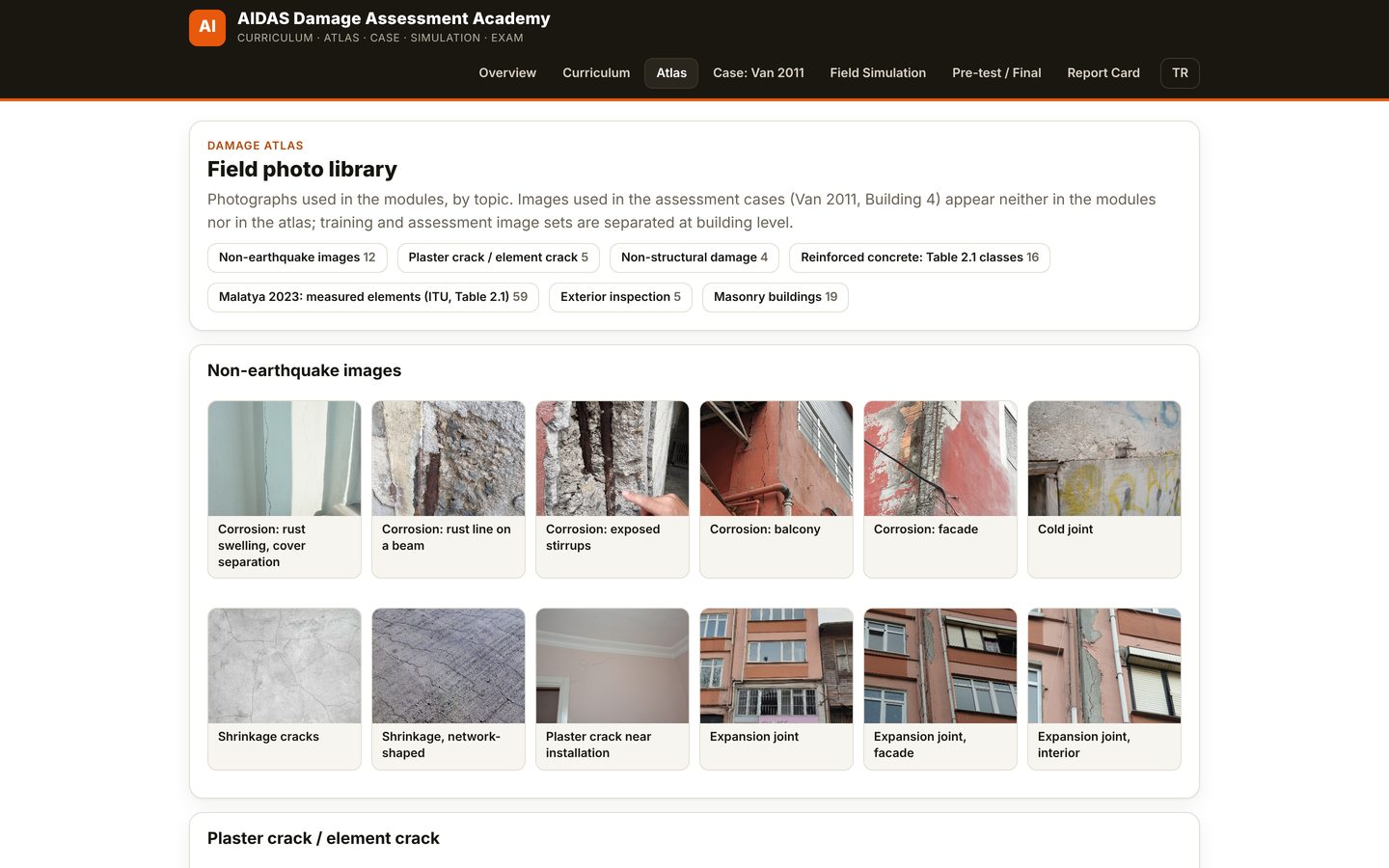
Damage atlas
A photograph library drawn from the Ministry’s 2019 training material and the measured Malatya 2023 examples, with non-earthquake damage and plaster cracks under separate headings.
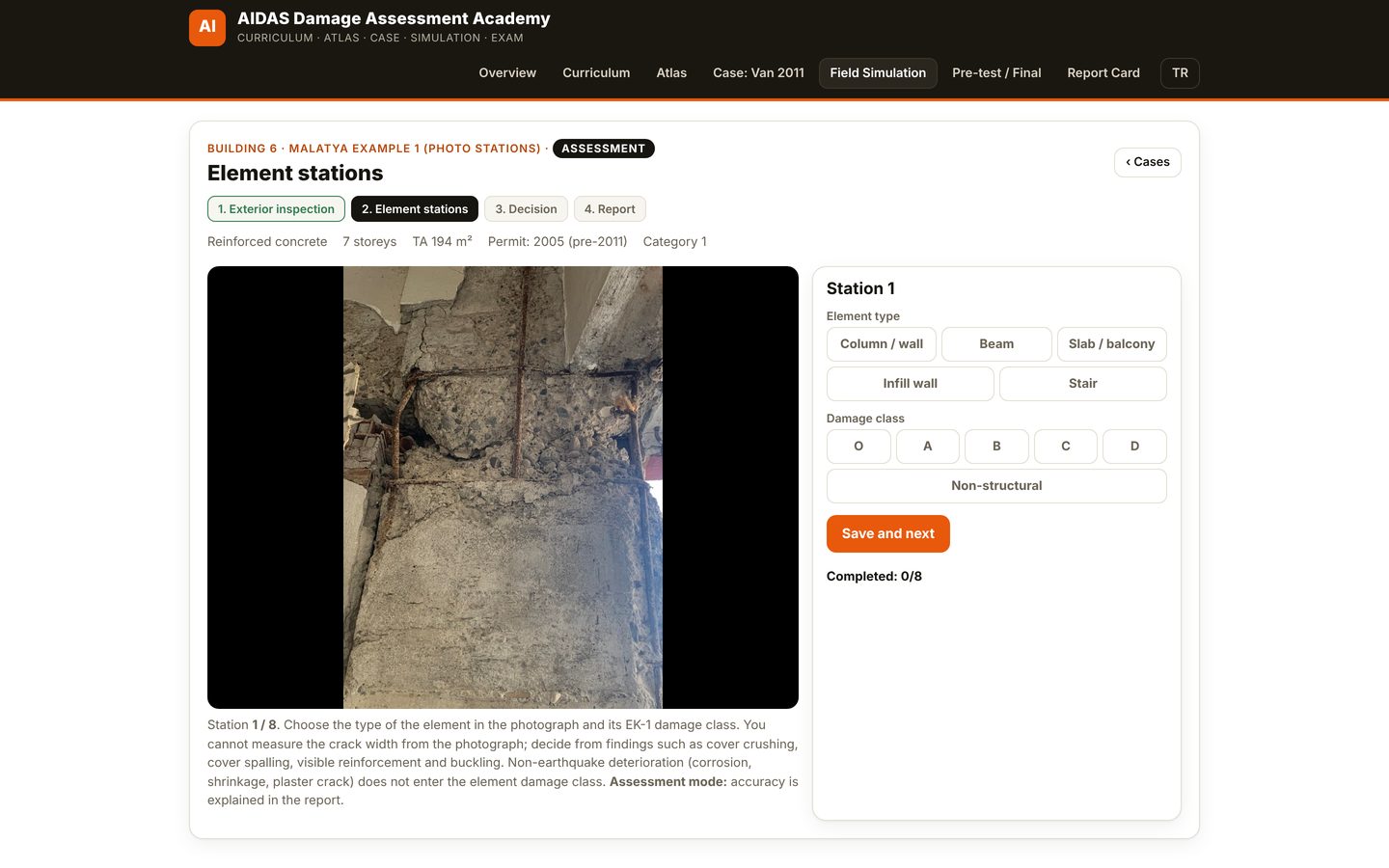
Field simulation
Three UAV video cases, one exterior-photograph safety case, one Category-2 calculation case and two photo-station cases. Instant feedback in practice mode; a single attempt in assessment mode.
AI second opinion
After you commit, a vision–language model assesses the element with the text of Table 2.1 and returns a class, a confidence score, visible findings and a plain statement of what cannot be measured. Apply it or keep your decision; both are logged.
Pre-test, final and certificate
Parallel forms drawn from a 37-item bank; learning gain, a competency profile and a certificate once the conditions are met.
Instructor panel
Trainee progress, case results and AI interaction logs on one screen, with export and group management.
The programme in four steps
Measure your starting level, learn, practise, and test yourself blind.
Pre-test
15 items; your starting level is recorded and does not enter the report card.
Curriculum
Eight modules, each with a short quiz.
Practice
The Van 2011 case and seven virtual field cases: exterior observation → enter or decide from outside → count → decision → report.
Final and certificate
A parallel final form; the report card is a competency profile, not a single score.
You first, then the AI
The assistant in the platform is not a detector but a logged second opinion. For the element you mark, you first choose your own element type and damage class; only then can the assistant be called.
It works with the verbatim text of EK-1 Table 2.1 and every answer states what it saw, which class it suggests, how confident it is and what cannot be measured from the image. Crack width cannot be measured from a photograph, and the assistant says so.
Your first decision, the suggestion and your final decision are stored on the server. That record is the data of a study on when trainees should and should not rely on AI; it never enters your score.
- No suggestion before your decision
- Table 2.1 text verbatim
- Confidence score and limitation sentence
- Every interaction logged, never scored
Screens
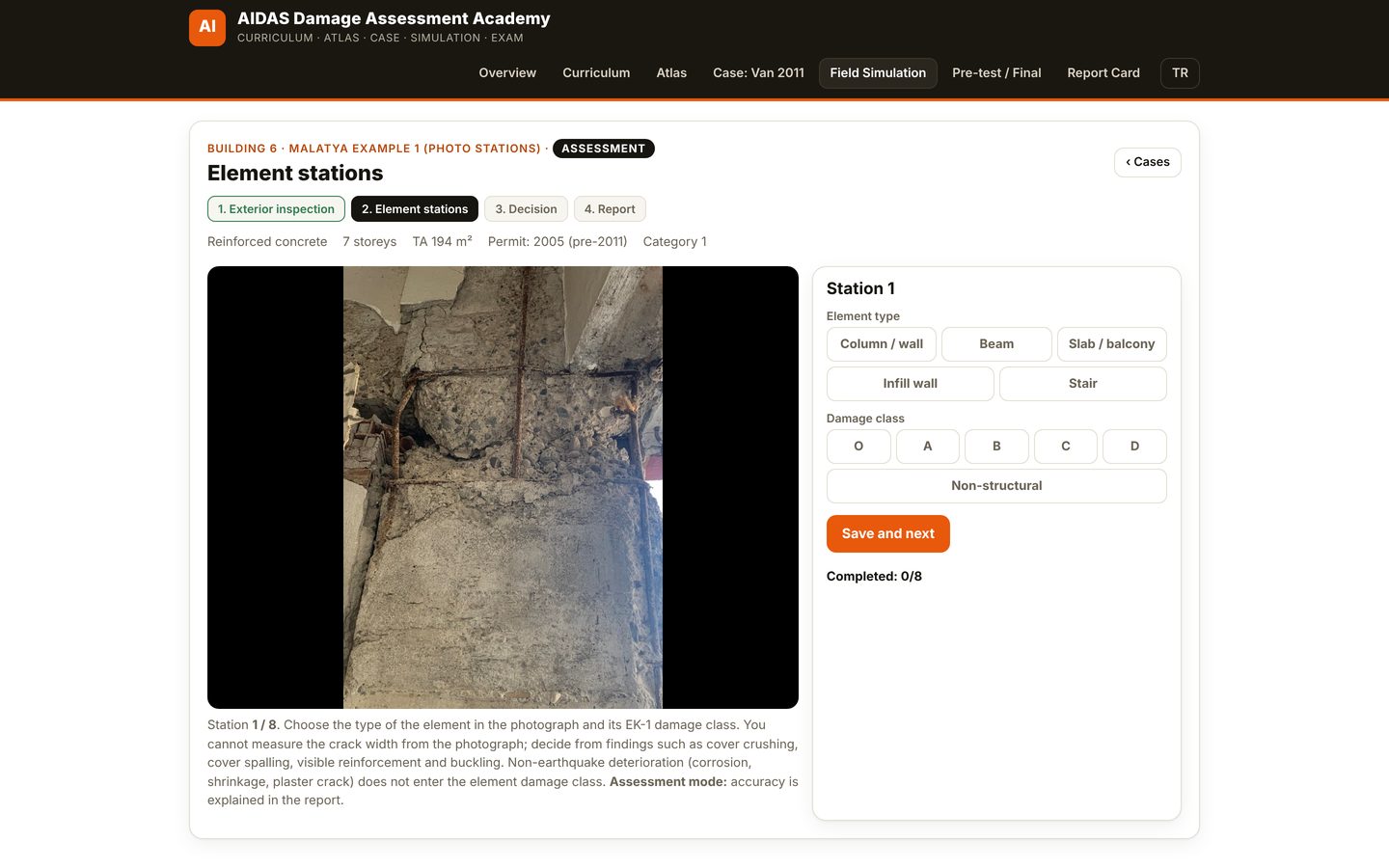
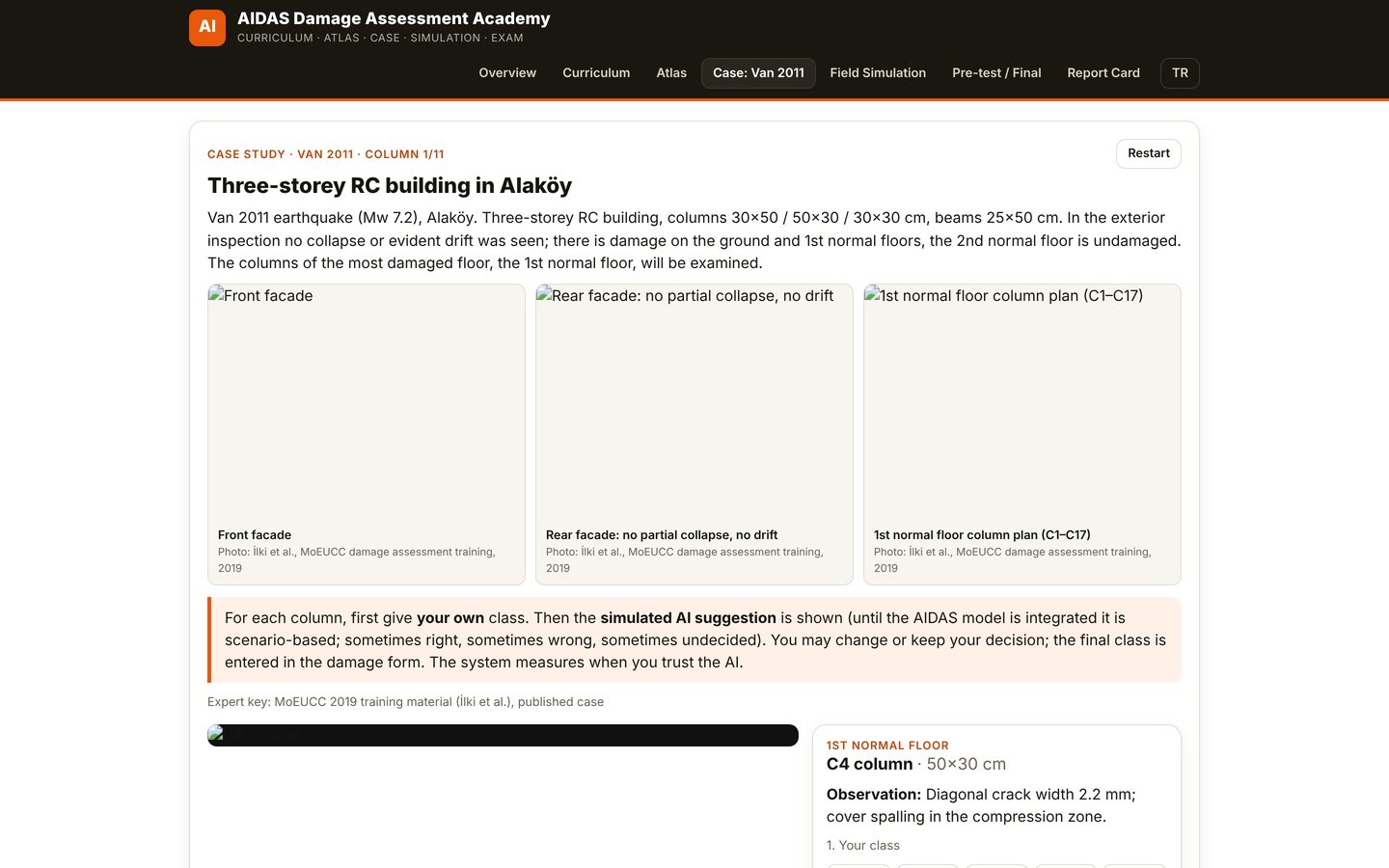
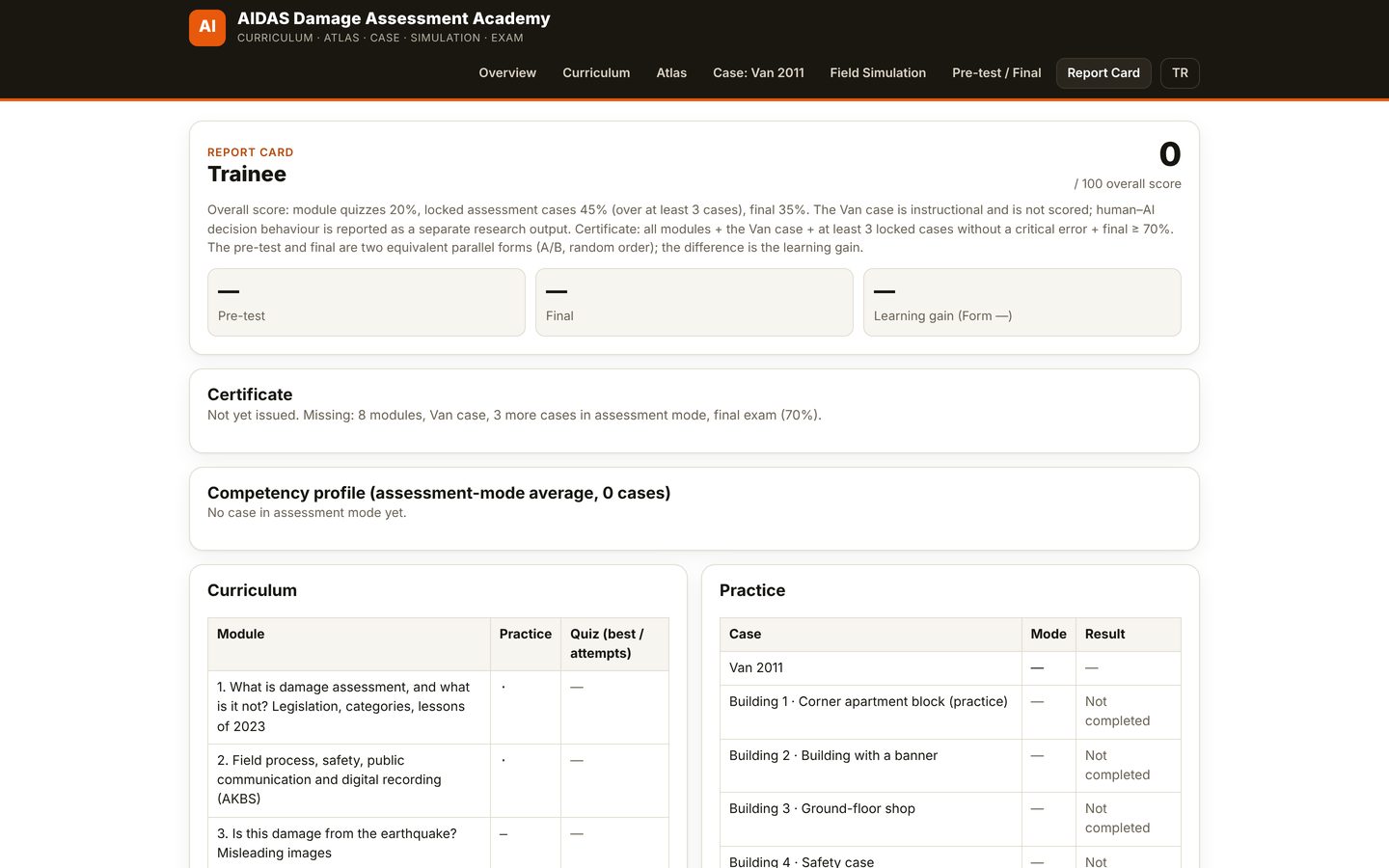
Introduction video
The platform in three minutes: curriculum, atlas, a field case and the AI second opinion.
User guide
Step-by-step guide for trainees and instructors; read it as a page or download the PDF.
The project
AIDAS is an output of the project “Post-Disaster Damage Assessment Training Platform Development”, funded under the TÜBİTAK 1001 programme (Principal Investigator: Prof. Dr. Bahar Demirel, Fırat University). It grew out of the TÜBİTAK 1002-B dataset study 123R008 carried out in Elazığ after the 6 February 2023 earthquakes and discussions with the Elazığ Directorate of the Ministry of Environment, Urbanisation and Climate Change.
Aim
To develop the damage-assessment skills of post-disaster response teams with realistic scenarios and to document competence measurably.
Basis
The 2025 Regulation on General Rules for Post-Disaster Building Damage Assessment, Annex EK-1; the Ministry’s 2019 training material; the ITU/Ministry training examples from Malatya (2026).
Data
UAV recordings of buildings awaiting demolition in Elazığ, measured field photographs and expert-panel labels. Participant records are pseudonymous; the consent text is shown in the platform.
Research
Controlled studies run on the platform are reported in peer-reviewed publications; analysis plans are registered on the Open Science Framework.